Problems › Get it looked at now
A wall bowing or leaning in
A basement wall that curves inward, or has a horizontal crack part-way up, is being pushed by wet soil outside it. It will not straighten itself and the movement does not stop on its own. Bracing or anchoring it early is a routine repair; leaving it until the wall has moved a long way is not.
What is actually happening
The soil outside a basement wall gets heavy when it is wet and expands when it freezes. Block and poured walls are strong against the weight of the house pressing down on them and much weaker against sideways pressure. Over years the wall gives a little, cracks along a mortar joint, and starts to curve inward at the crack. The wettest side of the house, or the side where downspouts dump water, usually goes first.
Signs to look for
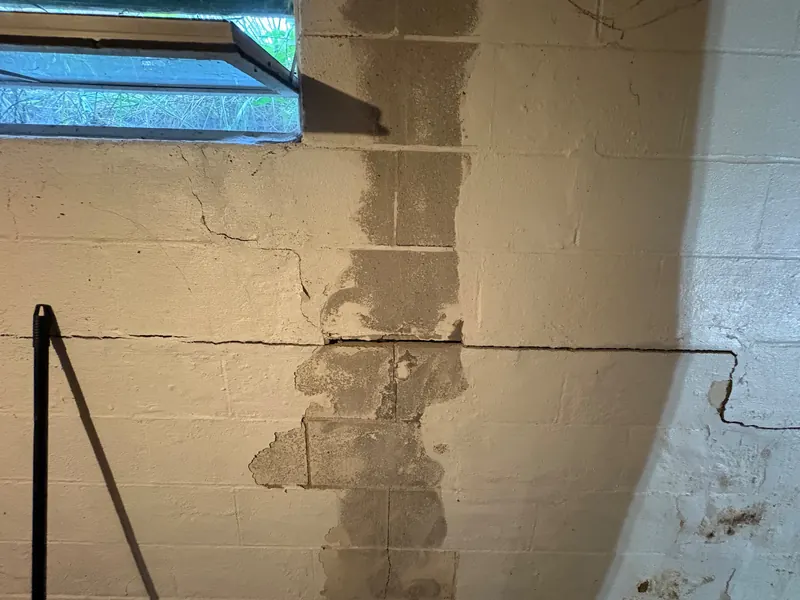
- A horizontal crack part-way up the wall, or a stair-step crack that is widest in the middle.
- A visible curve, or a gap behind a straight board held against the wall.
- The top course of block pushed in past the sill, or the wall leaning at the top.
- Cracks that have been patched before and have opened again.
What fixes it
- Wall anchors. Steel plates on the inside of the wall connected by rods to anchors set in stable soil out in the yard. They hold the wall and can be tightened over time. Installed with small holes outside, no full excavation.
- Carbon fiber straps. Bonded to the inside of the wall to stop further bowing. Used when the wall has moved only a little; low profile, so the wall can be finished over afterwards.
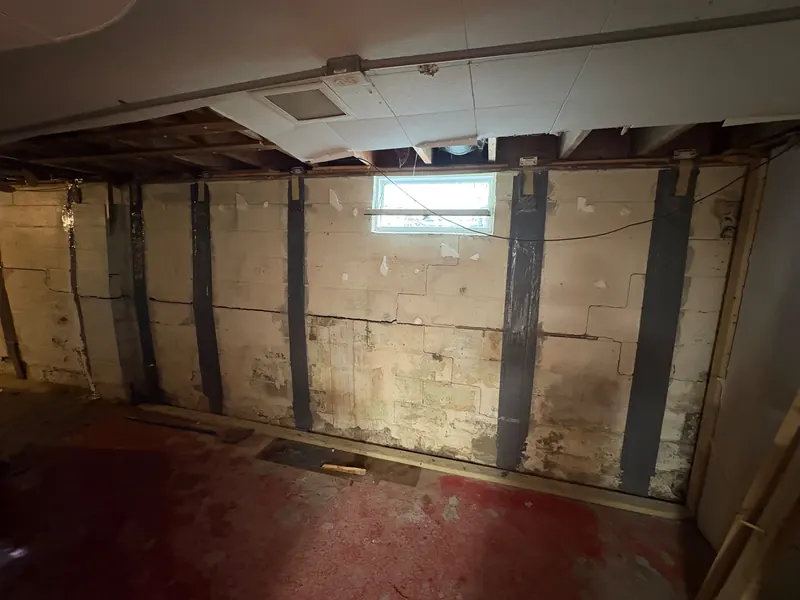
- Steel braces. Steel beams set against the inside of the wall, anchored to the floor and the joists above. Used when there is no room outside for anchors.
- Excavation and rebuild. When the wall has moved a long way, the outside is dug out, the wall straightened or rebuilt, and drainage added. The most disruptive and most expensive option, and the one that waiting leads to.
Whatever holds the wall, the water outside it needs handling too: downspouts extended, grading corrected, and sometimes drainage added, so the pressure does not just build again.
What makes it cheaper or more expensive
- Cheaper: a short wall that has moved a small amount, caught early, with room outside for anchors.
- More expensive: a long wall, a large amount of movement, tight access outside (a driveway or a neighbour's wall), or a finished basement that has to be opened.
If you do nothing
The wall keeps moving, slowly, each wet and freezing season. The repair moves from straps or anchors toward excavation and rebuilding, and the cost climbs with it. A wall that has moved far enough is a safety issue as well as a cost one.
What the repair looks like
Photos from a completed job, taken by the crew. Not staged.
Questions people ask
How can I tell if a wall is bowing?
Hold a straight board or a long level flat against the wall from floor to ceiling. A bowing wall shows a gap in the middle. A horizontal crack part-way up, or a stair-step crack that is wider in the middle of the wall, usually goes with it.
Will a bowing wall collapse?
Not suddenly in most cases; the movement is slow, over years. But it does not stop or reverse on its own, and the further it moves the more the repair costs. That is why this one is "get it looked at now" rather than "watch".
Do you have to dig up the outside?
Often not. Wall anchors and carbon fiber straps are installed from inside with little disturbance. Exterior excavation is used when the wall has moved a long way or the outside needs work anyway.
Can the wall be straightened?
Sometimes, gradually, with anchors that are tightened over time, particularly if the soil outside is excavated to relieve pressure. In many cases the aim is to stop further movement rather than to make the wall perfectly straight again.
What causes it in the first place?
Wet, clay-heavy soil expanding against the wall, freezing and thawing in winter, and poor drainage on that side of the house. Fixing the drainage is usually part of the repair so the pressure does not simply return.